
CBDT has been given a collection target of Rs 5.69 trillion in personal income tax in the fiscal year 2019-20 - 19.2 per cent more than the Rs 4.77-crore collection in the previous year.

To validate and continue using the existing PAN cards, citizens will have to link them to Aadhaar. Or else, they will be permitted to use Aadhaar instead for filing returns and while making other high-value transactions, specified under the Income Tax Act.

Nirmala Sitharaman has designed the revenue mix in such a way that while Centre's share in taxes would grow a massive 25 per cent, states' share would grow a dismal 6 per cent.

For insurance intermediaries like brokers, insurance repositories, third-party administrators, etc, 100 per cent FDI may be permitted.

More than half of the total subsidy provisioning, amounting to 54 per cent, is going towards food subsidy, which is estimated at Rs 184,220 crore for 2019-20 - a 7.5 per cent increase over the revised estimates for 2018-19.

The studies found that sectors with the highest unaccounted income included real estate, mining, pharmaceuticals, pan masala, gutkka and tobacco, bullion and commodity markets, film industry, educational institutes and professionals.
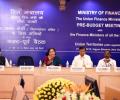
Sitharaman exhorted the states to work together with the Centre, stating that while the Union government sets the direction of economic growth, it is for the states to ensure effective implementation on the ground.

This meeting has led to the deferment of the Goods and Services Tax (GST) Council meeting by a day.

Despite a steady collection rate, the government faces a steep Budget target of Rs 6.1 trillion for CGST for 2019-20.

The US is pressing for taxing digital economy through the 'marketing intangibles' principle and the UK through a 'user-base' principle.

The report, floated recently, comes a few days after the government cancelled the registration of Bengaluru-based NGO Infosys Foundation for alleged violation of norms in receiving foreign grants.

The focus will be on tackling the unfinished agenda requiring immediate attention like tax structure for solar projects, uniform tax rate on state-organised and state-authorised lotteries, taxing non-potable alcohol besides certain changes in the law, extension for NAA and rate rationalisation.
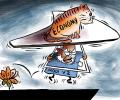
There is talk of a fresh approach to a new labour code as well as reforming land acquisition laws in such a way as to be politically.

Long-term funding was a requirement for infrastructure projects, and asset-liability mismatch in the banking system, impacts the access to finance for infrastructure projects. One of the key challenges would, however, be to get private sector back into investing.

The rates of price rise in many services used by the common man, including hospital and nursing, cook, domestic help and bus (fare), among others, have also touched double digits during the last four years, putting a burden on disposable income.
Infrastructure projects were the top picks for MPs, with 40% of the total funds spent on the development of railways, roadways, pathways and bridges.

CBDT feels 30% growth in income-tax not feasible.

The direct tax collections are likely to fall short of the revised Budget target by Rs 650 billion and, in fact, were Rs 150 billion lower than the original estimate for the fiscal

'A sum of Rs 6,000 a year is very significant for a small farmer whose land holding is very small and whose produce is very small. All these calculations on a daily basis are extremely unfortunate and an insult to farmers.'

With the two members quitting, the NSC now has only two members -- Chief Statistician Pravin Srivastava and NITI Aayog CEO Amitabh Kant.
 © 2026 Rediff.com - Investor Information - Advertise with us - Disclaimer - Privacy Policy - Sitemap - Feedback - About us - Terms of use - Grievances